
Table of Contents
- Start With Your Measurements, Not the Size Label
- How to Check Clothing Size Charts Accurately
- How to Spot Fake Online Clothing Stores Before You Buy
- Secure Payment Methods for Online Shopping
- Online Boutique Return Policy Best Practices
- Read the Fabric Composition and Product Description
- What Happens After Checkout: Shipping, Tracking, and Disputes
- Frequently Asked Questions
Last Updated: September 25, 2026
Start With Your Measurements, Not the Size Label
Most people shop by size label. That is the first mistake. Tips for buying clothing online safely start with a tape measure, not a tag. Size labels vary wildly between brands, and a "medium" at one shop can fit like a "large" at another. Your body does not change between stores. The label does.
How to Check Clothing Size Charts Accurately
Checking a size chart accurately means matching your own measurements to the brand's numbers, not guessing from the size you wear at other stores. The chart is the truth. Your usual size is just a habit.
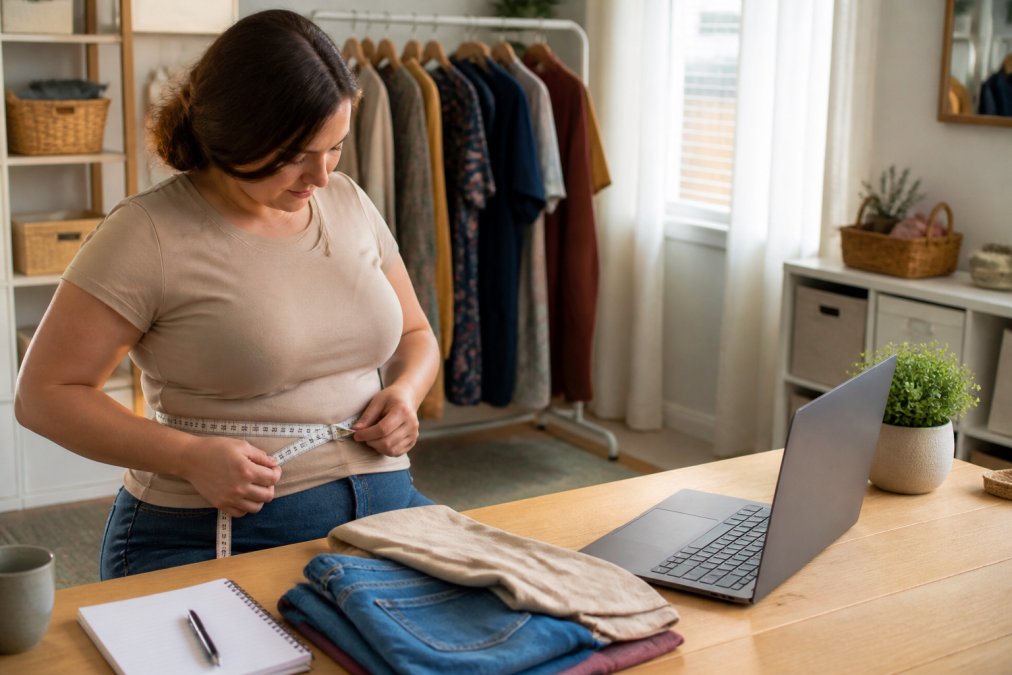
Here is how to do it right:
- Measure over light clothing or bare skin, not over thick layers.
- Keep the tape snug but not tight.
- Measure your bust at the fullest point.
- Measure your waist at the narrowest point.
- Measure your hips at the widest point.
- Write everything down in inches.
- Compare each number to the brand's chart, line by line.
Measure Yourself the Right Way
Stand up straight. Keep the tape level all the way around. A tape that slips down your back gives you a wrong number, and a wrong number leads to a bad fit.
When the Chart and the Reviews Disagree
Trust the reviews when they are consistent. If ten shoppers say a dress runs small, believe them. Many brands update their charts slowly, so real buyer feedback often beats the official numbers.
How to Spot Fake Online Clothing Stores Before You Buy
You spot a fake clothing store by checking its contact details, its reviews, and its prices. If a store hides who runs it, that is your first red flag. Real boutiques want you to know them.
Check the Contact Details and Business Footprint
Look for a real address, a working phone number, and an email you can actually reach. A store with no contact page is a store you should skip.
Spot the Drop-Ship and Counterfeit Signals
Drop-shipped and counterfeit sites share a few tells. Watch for these:

- Prices far below what the item could ever cost to make
- Stock photos used on many different stores
- Every item "on sale" all the time
- No size chart at all
- Shipping times listed in weeks, not days
- Brand names misspelled in the product title
Secure Payment Methods for Online Shopping
The safest payment method for online shopping is a credit card, followed by a virtual card or a digital wallet tied to your real account. Each one gives you a dispute path if something goes wrong. Debit cards, gift cards, wire transfers, and crypto offer little or no protection.
| Method | How it protects you | Main limitation |
|---|---|---|
| Credit card | Federal law limits your liability for unauthorized charges, and you can dispute a charge for goods never delivered or not as described | You are exposing your real card number to every site you use |
| Virtual credit card | A one-time or merchant-locked number linked to your real account; if the site is breached, the stolen number is useless | Not every store accepts them, and some issuers limit how many you can generate |
| Digital wallet (PayPal, Apple Pay, Google Pay) | The merchant never sees your card or bank number; the wallet sends a token instead | You must fund or link the wallet, and disputes run through the wallet's process, not your card issuer |
| Debit card | Limited dispute rights; the money leaves your account immediately | Your own cash is tied up while the dispute is resolved |
How to Set Up and Use a Virtual Card
A virtual credit card is a temporary number issued by your card company or a third-party service. You generate it in an app or online portal, set a spending limit and an expiration, and use it like a normal card at checkout. When the purchase is done, you can freeze or delete the number.
Why Digital Wallets Add a Layer
When you pay with a digital wallet, the merchant receives a token, not your card number. If that store is later breached, there is no card number to steal. The wallet also keeps your purchase history in one place, which makes disputes easier to document.
Checkout Safety Checks
Before you enter any payment details, run these checks:
Shit Bitch, You is Fine Clear Travel Bag →
- Look for "https" in the web address and the padlock icon in your browser
- Confirm the checkout page is on the store's own domain, not a redirect to a third-party page you do not recognize
- Avoid shopping on public Wi-Fi; use your phone's cellular connection or a trusted network
- Never email your card number, and never send it through a chat window
- Turn on transaction alerts with your card issuer so you see charges in real time
A valid SSL certificate protects the data you send to the site. It does not prove the store is honest, anyone can get a certificate, but its absence is a hard stop.
Online Boutique Return Policy Best Practices
A good return policy is clear, easy to find, and written in plain language. Read it before you buy, not after. The best online boutique return policy best practices come down to three things: a stated window, a clear process, and who pays for shipping.
Check these before checkout:
| What to Check | Good Sign | Red Flag |
|---|---|---|
| Return window | 30 days or more | "Final sale" on everything |
| Refund vs. store credit | Full refund to your card | Credit only, no cash back |
| Return shipping | Free or flat rate | You pay high fees |
| Condition rules | Tags attached, unworn | Vague or hidden rules |
| Process | Online form or portal | Email only, no tracking |
Read the Fabric Composition and Product Description
Fabric composition tells you how a garment will feel, wash, wear, and fit, before you ever try it on. A product description that skips the fabric is hiding something. Read both, and read the percentages, not just the fiber names.
How to Read a Blend
The order of fibers on the label matters. The fiber listed first makes up the largest share. A top labeled "95% cotton, 5% spandex" is a cotton garment with a little give. A top labeled "60% polyester, 35% cotton, 5% spandex" will feel slicker, hold color longer, and breathe less.
- Cotton: breathable, easy to wash, can shrink in a hot dryer. Expect some relaxation after a few wears.
- Polyester: durable, holds color and shape, less breathable. High percentages can feel clammy in heat.
- Spandex or elastane: adds stretch and recovery. Even 2-5% changes how a garment moves and how forgiving the fit is.
- Rayon or viscose: soft and drapey, prone to shrinking and stretching out. Often needs gentle washing and flat drying.
- Linen: cool in heat, wrinkles easily, softens with wear. Usually no stretch unless blended.
- Wool: warm, odor-resistant, needs careful washing. Can felt if exposed to heat and agitation.
- Nylon: strong and lightweight, often used in activewear and hosiery. Low breathability at high percentages.
Use Composition to Predict Fit
Stretch percentage is the single most useful number for predicting fit online. A rigid cotton poplin shirt has no give, if the chart says your bust is at the top of a size, size up. A ponte knit with 5% spandex will forgive a half-inch difference. A ribbed knit with 10% spandex may relax after wearing, so a snug fit at first is normal.
Read the Care Label Before You Buy
Care instructions are part of the price. A garment that says "dry clean only" costs you money every time you wear it. A garment that says "hand wash cold, lay flat to dry" costs you time. Machine-washable, tumble-dry-low is the lowest-effort combination.
- A "linen" top that is mostly polyester
- A "wool coat" with a low wool percentage and a high acrylic or polyester share
- A "pre-shrunk" claim with no care instructions at all
- A "machine washable" claim paired with a dry-clean-only tag
What Happens After Checkout: Shipping, Tracking, and Disputes
After checkout, your job is to track the order and know your rights. Save your order confirmation and tracking number. If the package never arrives or arrives wrong, you have a paper trail.
If the seller will not help, you have options:
- Dispute the charge with your credit card company.
- File a complaint with your state attorney general's office.
- Report the site to the Federal Trade Commission.
Frequently Asked Questions
How can I tell if an online clothing store is legitimate?
Check three things before you buy: a real business address and phone number on the site, an SSL certificate (the padlock in your browser bar), and a return policy written in plain language with a physical return address. Search the brand name plus 'reviews' outside the site itself. Legitimate boutiques also publish clear contact details and respond to questions before purchase. If the only way to reach them is a web form and the About page has no names, slow down.
What are the signs of a scam clothing website?
Watch for prices far below every other retailer, countdown timers that reset when you reload, stock photos that appear on multiple unrelated sites, and payment pages that only accept wire transfers, gift cards, or cryptocurrency. Missing contact details, no return policy, and a domain registered within the last few months are additional red flags. Legitimate stores accept major credit cards and publish a dispute process.
What should I look for in an online boutique return policy?
Look for the return window (14, 30, or 45 days), who pays return shipping, whether refunds go back to your original payment method or only store credit, and whether sale items are excluded. A strong policy states the return address clearly and explains how to start a return. Before ordering, screenshot the policy. If a store buries it or changes it after your purchase, that is a sign to shop elsewhere.
How do I protect my financial information when shopping at a new online store?
Use a credit card rather than a debit card, since credit cards offer stronger fraud protection under federal law and let you dispute charges without money leaving your bank account. Some banks let you generate a virtual credit card number for one-time use. Confirm the checkout page uses HTTPS, avoid saving card details to new sites, and check your statement within a few days of ordering so you can flag anything unfamiliar quickly.